|
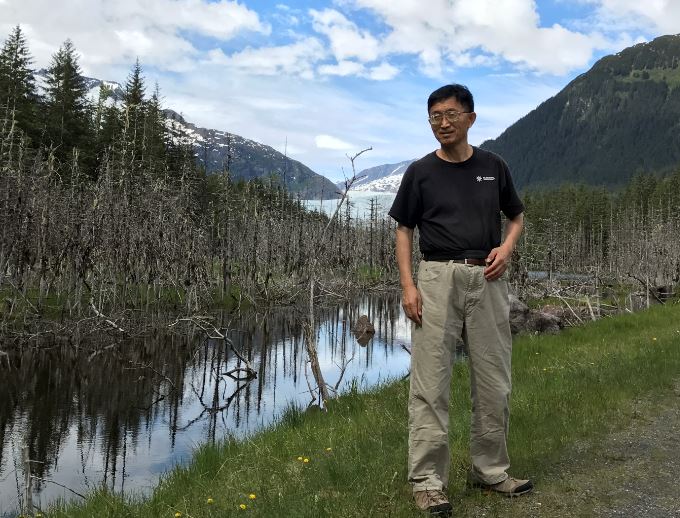
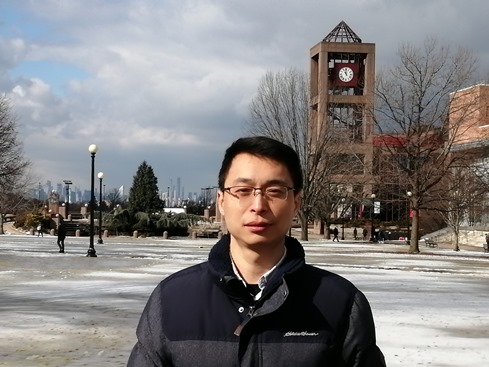
Professor Chuixiang (Tree)
Yi
CV
Principal Investigator
 |
|
The overall
goal of my research is to find links between carbon and climate: (1)
seeking observational evidence of how climate controls terrestrial
carbon sequestration from eddy-flux measurements; (2) modeling of how
carbon dynamics changes climate through a climate-feedback model.
On a large scale, my research group is trying to extract a simple picture (or
theory) to understand the carbon-climate dynamics at biome level
generally.
On a small scale, my research group is focusing on turbulent transport processes of
carbon, water, heat, and momentum over complex forested-terrain.
Scientific problems my group is trying to solve include: (I) turbulent
transport theory within a forest layer, which is a persistent knowledge
gap because
the
classic theories do not work within canopies; (II) advection issues
caused by complex terrain in eddy-flux measurements; (III) instability
of forest flows over complex terrain; and (IV) land-surface
parameterization of weather and climate models including
vegetation-layer dynamics.
In addition,
my group is developing a nonlinear paleoclimate model to understand
the nonlinear control mechanisms of abrupt climate change.
The primary research approaches of my group are nonlinear dynamics, analytical modeling, numerical
modeling, statistical modeling, and intensive field measurements. |
| |
|
|
|
Distinguished
Professor
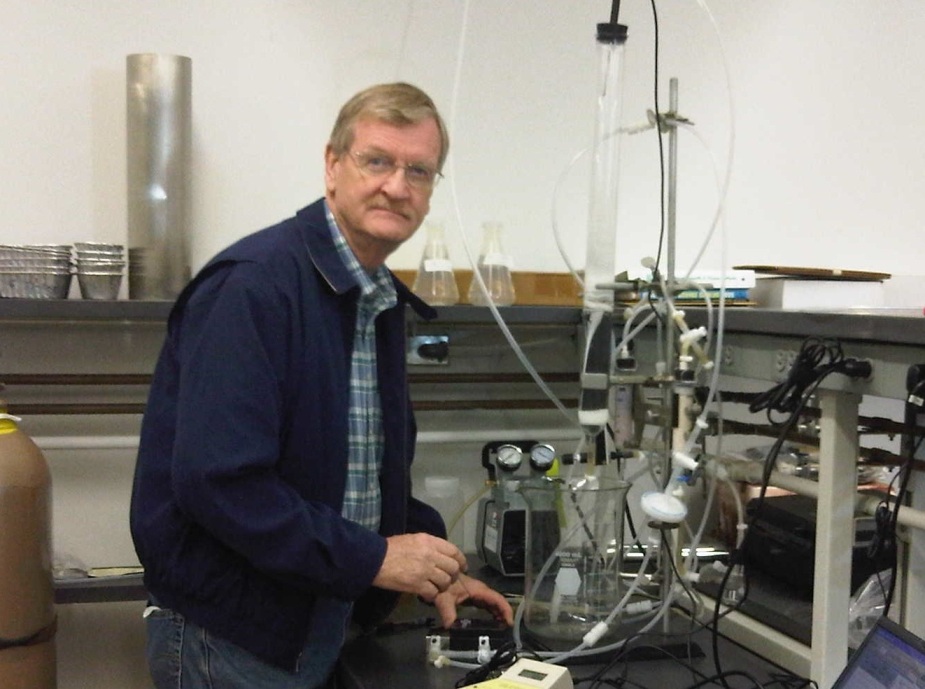
George Hendrey
Principal Investigator
 |
|
Forest-atmosphere CO2 exchange:
Estimating net primary production via the eddy
covariance flux method does not work well in hilly to
mountainous terrain. Chuixiang Yi and I are setting up
an experiment in the Black Rock Forest where we intend
to develop methods to improve the use of eddy-flux to
estimate NPP in complex terrain. We are establishing a
suite of instrumented eddy-flux towers over a single
hill for micrometeorological research on advective flux.
CO2 absorption:
An expanding area of interest for me is how inorganic
substances react with atmospheric CO2. I have
established an apparatus for studying such reactions and
their associated kinetics.
Plant responses to CO2 enrichment:
Much of what is known about global ecosystem responses
to future increases in atmospheric CO2 has been gained
through Free-Air CO2 Enrichment
(FACE) experiments of my design. All FACE experiments
exhibit rapid variations in CO2
concentrations on the order of seconds to minutes. I
have shown that long-term photosynthesis can be reduced
as a consequence of this variability. Because of this,
all FACE experiments tend to underestimate ecosystem net
primary production (NPP) associated with a presumed
increased concentration of CO2. I am working
on development of a NPP correction based on
photosynthesis experiments in which CO2 is
oscillated in a controlled way in a leaf chamber while
measuring photosynthetic fluorescence and/or CO2
assimilation.
|
| |
|
|
|
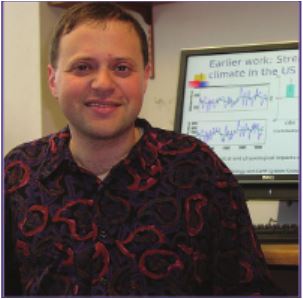
Professor John Wolbeck
Ph.D. Student

|
|
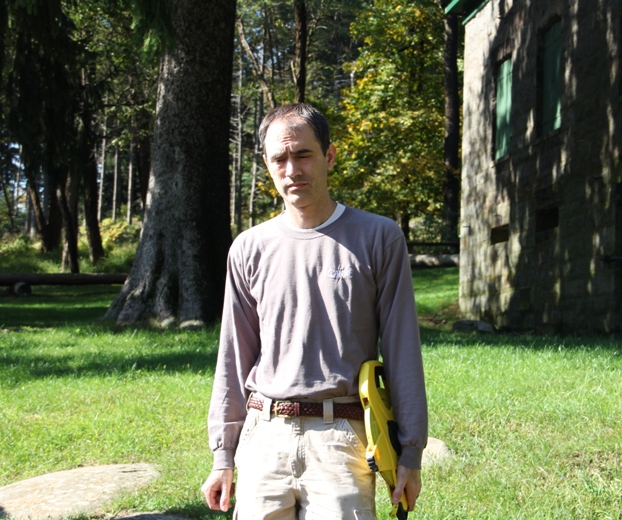
John Wolbeck is pictured
here test driving an electric/solar car that he and his students built.
The car is capable of traveling 50 mph for 40 minutes on a single charge
(unfortunately it does not have much room for luggage). His students
have recently began construction on a solar powered motorboat. John
races Sunfish sailboats in the summer and has a "renegade" iceboat
that he sails on the ice in the winter. The iceboat can reach speeds of
100 mph! Given his background it is only logical that his research
interests involve understanding the complex relationships of wind and
our environment. His fluid mechanics and instrumentation experience is
being put to use at the Black Rock Forest eddy flux Tower site for
"understanding canopy flows over complex terrain" and for modeling and
predicting the s-shaped canopy velocity profile under differing synoptic
conditions using canopy momentum transfer theory CMT.
John Wolbeck is a NYS
licensed Professional Engineer P.E. He earned his Bachelors degree in
Mechanical Engineering from UB, (State University at Buffalo), and his
Masters degree in Environmental Engineering from Manhattan College. John
teaches; Engineering Statics, Dynamics, Solid Mechanics, Physics, and
Astronomy at SUNY Orange Community College where he is the Chair of the
Department of Science and Engineering. |
| |
|
|
|
Xiyan Xu
Ph.D. Student
 |
|
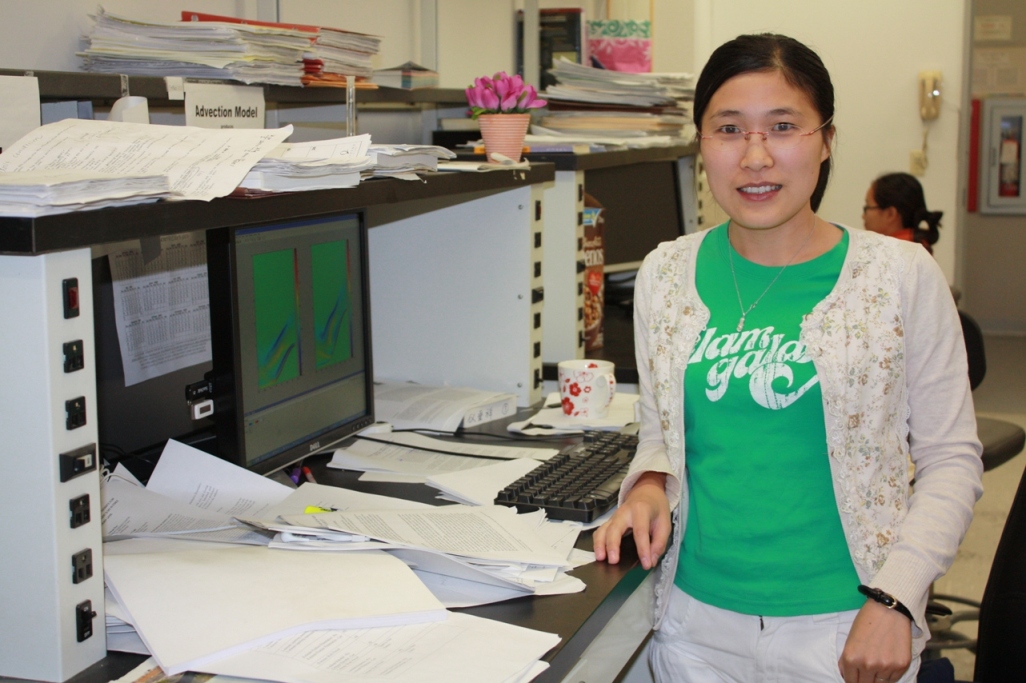
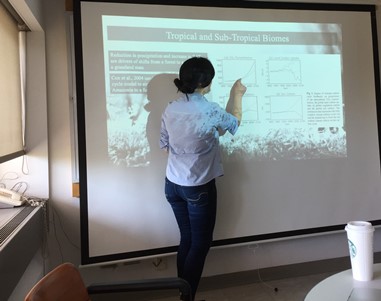
I received a B.S. from
Nanjing Institute of Meteorology. Now my interests focus on seeking
numerical solutions for CO2 transfer within canopy layer over complex
terrain. Heterogeneity in flow and CO2 distribution cannot be properly
accounted for by one dimensional tower-based eddy covariance technique,
causing significant uncertainties in evaluating net ecosystem exchange
of CO2 (NEE) in calm nights. I am using CFD method to solve the spatial
and temporal evolution for both flow and CO2 transfer within canopy
layer over complex terrain.
|
|
|
|
|
|
Suhua (Sue) Wei
Ph. D. Student

|
|
I received my B.S
in physics from Beijing Normal University in July, 2010. Now I am
working with Professor Yi to do research on biosphere-atmosphere
interaction. My research focuses on synthetic analysis of FLUXNET data
to understand global CO2 cycle and how future climate change affects
terrestrial CO2 exchanges with atmosphere in 21st Century. The long-term
goal of my research is using remote sensing and GIS to upscale
tower CO2 measurements to national scales.
|
| |
|
|
|
Christine Ramadhin
Ph.D. Student
 |
|
My undergrad
degrees were in Chemistry and Environmental Science. While working on my
Chemistry degree, I developed a strong interest in using scientific
principles to develop comprehensive protocols in monitoring and solving
environmental problems. Currently, I am working with Professor Chuixiang
(Tree) Yi to investigate the paleo-climate data to help explain and
predict current and future climate change. There are more than one
drivers (CO2, solar insolation, and others) responsible for climate
change and it should prove interesting to definitely determine which one
is most responsible for drastic changes in global climate.
|
|
|
|
|
|
Eric Kutter
Ph.D. Student

|
|
I earned a Master
of Science degree in Environmental Engineering from Rutgers University,
where I modeled stormwater flow and sediment transport. My Bachelor’s
degree is from Stevens Institute, also in Environmental Engineering. I
worked in New Jersey, New York and overseas as an environmental
engineer. Whenever necessary, I served as an advisor on environmental
issues (primarily climate change) for the Republic of Palau’s Mission to
the United Nations. Currently, I am doing my PhD in micrometeorology
with Professor Yi. My PhD thesis will focus on energy transport within
and above forest canopies over complex terrain. |
| |
|
|
|
Qianyu Zhang
Research Technician

|
|
I received Master Degree in Environmental
Engineering from Washington State University in 2012. Currently, I am
helping Professor Yi and Hendrey’s group to build up the eddy-flux tower
system in Black Rock Forest in New York.
|
| |
|
|
|
Caroline Farkas
Master Student |
|
I graduated from North Carolina State
University with a B.S. in Meteorology. I recently completed an
internship at Wageningen University in the Netherlands doing research on
the effects of urbanization on the local temperature in an area called
the Randstad. Using the Weather Research and Forecast (WRF) model, I
studied the temperature data of a specific heat wave using different
degrees of land use, including a future scenario. I also started to
research possible changes to a city to help reduce the
temperature during the summer by a small amount. My interests in the
atmospheric sciences are broad and diverse and right now I am really
interested in climate research!
|
|
|
|
|
|
Alan Mason
Master Student

|
|
I received my B.S. in Environmental
Science from Monash University, Australia in 2002. I am currently
pursuing a M.S. in Applied Environmental Geoscience, and working with
Professor Yi analyzing FLUXNET data in order to quantify current and
future CO2 changes due to variations in climate. I am extremely
interested in the tower instrumentation utilized in data collection, as
I believe an enhanced understanding of these tools will augment my
analytic capabilities regarding climate data. With the knowledge gleaned
from these studies, I believe we will be able to provide objective
explanations for carbon flux and other climate phenomena.
|
|
|
|
|
|
Anand Dookie
Undergraduate Student

|
|
I am currently a freshman at The City
University of New York, Queens College studying Physics and Geology. My
greatest interest lies in the fields of climatology and meteorology.
Currently, I am doing research on atmosphere-biosphere interaction in
Dr. Yi’s Lab based on AmeriFlux datasets. While researching with Dr. Yi,
I hope to gain an in-depth understanding of professional level
research.
|
| |
|
|
|
Kevin Clinton
Undergraduate Student

|
|
I am undergraduate
student in a geology major. I want to focus not only the Earth's past,
but, the future as well. I am doing research in Prof. Yi's Lab on how climate change
affects terrestrial carbon cycles based on FLUXNET data analysis. |
| |
|
|
|
Max Trukhin
Undergraduate Student
 |
|
Global climate change is a highly complex
and dynamic process that influences policymaking, economics, and
culture--making it that much more imperative that a better scientific
understanding of the fundamental mechanisms governing climate are
developed. It is my goal to contribute to the scientific paradigm in the
hope that a growing wealth of knowledge about our planet will enhance
policymaking and the development of effective technologies. Alongside
Professor Yi, I am researching the mechanisms that govern regional
vulnerability to drought.
|
| |
|
|
|
Hugh Han
High School Student

|
|
I am a currently
junior at Commack High School. I am enthusiastic about mathematics,
science, and engineering because the vast number of research topics
seems endless, and fascinates me. I am interested specifically in Dr.
Yi's research involving extreme climate conditions and climate change
and the general field of environmental and atmospheric sciences; this is
a field I may want to study in the future. I like to do research not
only to gain the experience for myself, but to discover new things that
could possibly benefit others and in the future, even impact the world.
|
| |
|
|
|
Chun Wu
High School Student

|
|
I am a junior at Forest Hills High
School. I love math and any kind of science because it helps me
understand the things around me. Helping Professor Chuixiand Yi's
research project gives me an idea of how professional scientists would
work. I wish I can learn more about the environment and save this
knowledge for future use.
|
|
|
|
|
|
Past Members
|
Max Wang
High School Student (2010-2012)

|
Jingxin Wang
Post Doctorial Fellow
(2011-2012)
 |
Lydia Seyoum-Christian
Research Assistant (2011)

|
|
Zhiwen Luo
Visiting Ph.D. Student
(2009)

|
Hongbin Chen
Post Doctorial Fellow
(2010-2011)
 |
Kailin (Pepper) Kuo
Undergraduate Student
(2010)
 |
|